
Though 1974 is a fair way back, I still have strong memories of then: it was certainly a momentous year for me. That was a time when Australia was rapidly moving forward as a nation, feeling more independent, and increasingly assured of our place in the world. Change occurred across much of the nation as memories of the staid Menzies years were being left well behind. In 1974 road signs changed from imperial to metric, Richmond went back-to-back with VFL flags, Australia’s first credit card was introduced, and the Federal government faced a mid-term election. Long hair was in vogue, flairs and platforms epitomised much of the fashion, the Pill was liberating women, with of course, the music charts rocking.
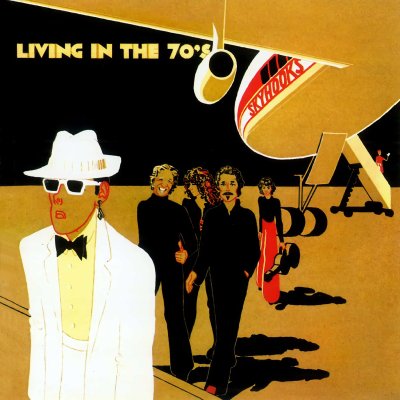
On October 7, 1974, Melbourne band Skyhooks released their debut album, Living in the 70’s. The album followed the single of the same name released in August that year. The single went well, the album broke records as Australian music, Australian culture, set forth into an exciting new period.
Recorded at the TCS studios during June, July 1974, Living in the 70’s was produced by the legendary Ross Wilson, best known as the frontman of Daddy Cool. Album sales started slowly; however, it gathered momentum early in 1975. The release of ‘Horror Movie’, the second single off the album, provided the album sales a powerful impetus. The album then spent 16 weeks atop Australia’s music charts. For many years it remained the biggest selling Australian album selling over 330,000 copies.
‘Horror Movie’ rocked up the charts reaching number one for two weeks in March 1975. It was also voted Australian record of the year at the King of Pop Awards with Living in the 70’s voted album of the year. The Living in the 70’s album provided both controversy and success, as six of the ten songs were banned from radio air play but with the two big singles the title track, and ‘Horror Movie’, climbing into the charts, album sales surged in 1975.
In this period Australia was slowly exiting a serious cultural cringe. Australian singers had sung about ‘Arkansas Grass’, ‘St Louis’, ‘Pasadena’, whilst our actors often spoke in British accents. This all started changing with Skyhooks’ Living in the 70’s playing a major role in the change. They weren’t the only performers breaking this cultural cringe but songs like ‘Balwyn Calling’, ‘Lygon Street Limbo’, were songs about life in metropolitan Australia that people related to. This corresponded with a progressive mood, actions/events, about Australia moving forward in a positive direction.
Coincidentally, a bold new TV show Countdown, hit our screens around this time. It became the most popular music show in the history of Australian TV. There’d been earlier Australian TV music shows like Hit Scene and GTK, but Countdown being beamed into millions of Australian households during Sunday night dinner time was a revelation. One hour of the latest music in your lounge. This of course coincided with the introduction of colour TV. Australia was changing rapidly.
Skyhooks were formed in 1973 when Eltham based bassist and songwriter Greg Macainsh and his high school drummer friend, Imants ‘Freddie’ Strauks, brought together other talented young musicians to form a band that became one of Australia’s biggest ever. By 1974 the line-up saw Macainsh, Strauks, with guitarists Bob ‘Bongo’ Starkie and Red Symons fronted by irrepressible lead singer Graeme ‘Shirley’’ Strachan, create Australian music history. Combining extravagant costume, glam, daring lyrics, all of this on top of rocking tunes, they quickly attracted strong fan support. After the success of Living in the 70’s their dedicated fan base helped make them the most popular band in the country. Throughout the rest of the decade Skyhooks remained one of the most beloved Australian bands.
Skyhooks broke up in the early 80s, though there were regular reunions. Red Symons and ‘Shirley’ Strachan found new successful careers in more mainstream media roles. Sadly, ‘Shirley’ is no longer here, tragically killed in a helicopter crash back in August 2001.
Fifty years later we can celebrate and commemorate the release of Skyhooks’ Living in the 70’s album which broke all previous records for sales of an Australian album, with over 330,000 copies sold. It reached Number 1 on record charts around Australia, as did the second single from the album, ‘Horror Movie’. And it sung of a new confident Australia wanting to be proud of who we were, whilst making our place in the world.
In October 2010 it was rated as the 9th best Australian album with the National Film and Sound Archives of Australia, adding it to their Sounds of Australia registry. As we approach the albums’ fiftieth anniversary, do yourselves a favour and give it a good listen. Enjoy.
Glen!
To return to our Footy Almanac home page click HERE.
Our writers are independent contributors. The opinions expressed in their articles are their own. They are not the views, nor do they reflect the views, of Malarkey Publications.
Do you enjoy the Almanac concept?
And want to ensure it continues in its current form, and better? To help things keep ticking over please consider making your own contribution.
Become an Almanac (annual) member – click HERE.


Terrific piece. Brought back lots of memories.
The lyrics bring all sorts of double entendres/euphemisms to mind but let’s just leave it at ‘a classic album’!
Fantastic reminisce Glen. I discovered Skyhooks in the early 1990’s through the new single “Jukebox in Siberia” and have been a massive fan ever since. Such a brilliant album that holds up unbelievably well both musically and lyrically.
Thanks Glen! The social context around this album’s so important and you capture this well. I came to it as a teenager, and it was everything rock music could be: thrilling, dangerous and performed with great energy. In time I’m probably more enthusiastic about Ego and Straight in a Gay, Gay World but all three are tremendous.
Thanks for this Glen!
Yep, that was the first album that I bought with my own $$$, although I’m still not sure how I afforded it.
First time I saw them was Memorial Drive, 20th Dec 1975 – the first of a few. They were my favourites until Split Enz came along, then they were bumped down the list when Radio Birdman and the Saints hit the scene.
I dropped them like a hot spud when Shirl left and Hot For The Orient came out. Never bothered tracking them down during many of their reformations. And don’t get me started on Jukebox In Siberia (sorry Luke).
They were great until they weren’t.
Such strong memories of listening to these songs even though I was only 7 or 8 and had no idea what they were really about. The influencer combination of Countdown and 3XY.
Great article Glen!
To my surprise, I was knocked over by the full name of the drummer – Imants ‘Freddy’ Strauks. I have been doing some research into my Latvian family history to discover my uncle was named Imants. He was only 14 when he & his mother (my grandmother) were removed from their Latvian property (which was named ‘IMANTAS’) by the Russians in 1946 and ‘resettled’ in Siberia (I wonder if they had a jukebox? Eventually, they probably did). My uncle Imants died in Siberia aged 30 but not before he was married and had a daughter. Fast forward and the daughter gets married and is able to resettle in Germany. They have a son and call him Imants, after his grandfather . It is only in the past year that I have made contact with Imants (my 1st cousin once removed). I would love to know more of Imants ‘Freddy’ Strauks’ family history, but my feeble google searches so far have led me nowhere.
Thanks for this, Glen!
It really is amazing that the “classic” (and most well-known) line-up of the Skyhooks – Strachan, Symons, Macainsh, Starkie, and Strauss – were only together for just under 4 years and only 3 albums.
Absolutely brilliant read Glen. At several points in the yarn I closed my eyes and transposed myself in my time machine to the mid 1970s – music, clothes, long hair, developing my patented cramming for exams technique, the magical Bankcard that just about everyone in Australia had mailed to them, the trailblazing crash and burn Whitlam years, World Series cricket, Essendon and Footscray a toss up for the worst VFL coloured shorts for the advent of colour TV, McDonalds arrives in Oz etc etc.
In the middle of all this, the Skyhooks cheekily captured the public imagination with songs such as those referred to above and my favourite “You just like me cos I’m good in bed”. Younger readers puzzled as to why several of their songs were censored could ask Dr Google to…ahem…check the lyrics.
Well played Glen!
RDL .
A well written read, thanks GD.
More than any other bands of the time (with respect to Daddy Cool etc) Skyhooks and Sherbet set the scene for Australia’s rock/pop transition. Countdown was critical to their success for sure. However, leading a national transition were key writers, playwrights, comics, film-makers in our arts, then there was early 70s politics as well as academia exploring our sense of self (national identity). Our popular music artists were directly responsive to those remarkable developments.
As a 12 year old, seeing Horror Movie on Countdown was one of the great tv moments of my teenage years.
Greg Macainsh, easily the equal to Vanda and Young, using ideas, phrases and humour reasonably unique to Australia, smashed down the establishment stronghold on our “culture”. This created an incredible rush of music artists that burst onto the scene in the late 70s, which flowed into the 80s and beyond. This more than their music (as good as some of it is) is Skyhooks legacy and that is staggering.
I’m not sure that this or other Skyhooks albums hold up that well today, but that is kinda irrelevant. They absolutely knocked down the conceptions and reality of aus rock and roll and our cultural developments are the better for their act of defiance and their art.
Great read Glen! I just interviewed Ross Wilson for my community radio program “In Focus” where he recounted discovering the first iteration of Skyhooks with Steve Hill on vocals and Bob Starkey’s older brother on guitar and no Red Symons. They were the support act for Mighty Kong at a lunch time University gig and he was taken by the lyrics and music to the likes of Toorak Cowboy, Lygon Street Lingo, Smut, What Ever Happened to the Revolution and of course Living in the Seventies.
He approached Macainsh to do some demo recordings and actually paid some upfront cash out of his own pocket to seal the deal. Soon after the older Starkey left the band and Steve Hill (who was a little erratic on stage) also left. Bob Starkey joined the band, Red Symons was recruited and someone new of a good looking “surfie type” who could sing-enter Shirley Strachan.
Wilson did a deal with Michael Gudinski and Mushroom records and of course produced their debut album. Living in the Seventies which went on to surpass the previous highest selling Australian album which was Ross Wilson’s band formed in 1971 Daddy Cool with Daddy Who? Daddy Cool.
Highly interesting piece that evokes an era particularly well – thanks, Glen.
‘Living in the Seventies’ is certainly a landmark album in Oz rock history, maybe in some socio-cultural respects, THE landmark album, but I don’t feel that song to song it stands up that well these days, primarily because it was such a creature of its time in terms of implied ( and sometimes overtly expressed) attitudes to women, the gay community and the like. Bits of the album are hard for me to listen to now. That said, certain classics remain like ‘Carlton’, and I believe that in purely musical terms (often Red’s guitar work and Freddy’s drumming) the album is pretty darn good.
Great article Glen. I only discovered Skyhooks in the 80s after they broke up but they were a great band. Sadly Whatever happened to the Revolution turned out to be prophetic as well.